
Education and employment rates among King County residents grow, but inequities persist
Income and employment are directly tied to overall well-being among individuals, families, and communities. When people have access to educational and economic opportunities, this can result in better access to healthcare, decreased rates of chronic disease, increased access to high-quality basic needs, and improved opportunities for generational wealth. Income inequalities, on the other hand, can increase chronic stress and disease, decrease social connectedness, and impact an overall community’s ability to thrive. So, what does the data say about how King County is doing related to education, employment, and income?
Starting with education, King County high school students are graduating at higher rates than ever with 87% of high schoolers graduating within four years in 2022, compared to 79% in 2014. Over this time period, the greatest increases in high school graduation rates were among the Tukwila (55% to 87%) and Highline school districts (63% to 84%), migrant students (39% to 65%), and students experiencing homelessness (41% to 60%), as well as Black (66% to 83%), Native Hawaiian/Pacific Islander (62% to 78%), and Hispanic students (62% to 77%). While timely high school graduation rates increased in King County and many disparities lessened, some gaps continue where further investments in local student, family, and school support could improve student outcomes. For example, students experiencing homelessness (60%), migrant students (65%), American Indian/Alaska Native students (68%), and students who are learning English (70%) had the lowest rates of high school graduation in 2022.
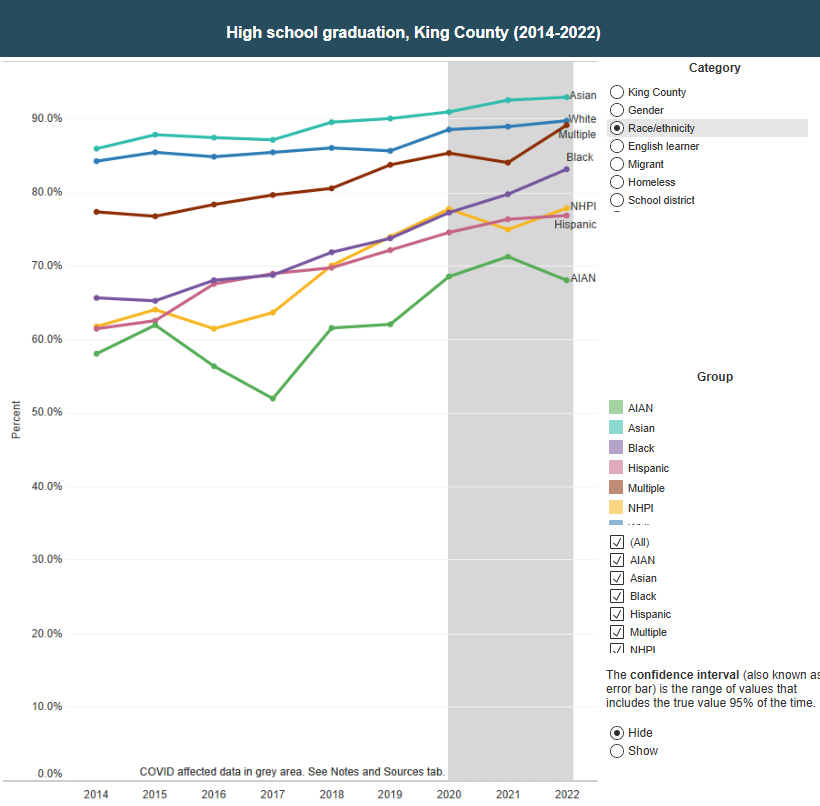
Data Source: Office of the Superintendent of Public Instruction
Educational attainment among adults is also increasing. The percent of adults with a bachelor’s degree rose from 49% in 2014 to 58% in 2023. However, disparities still exist. Adults who are least likely to have a bachelor’s degree include Native Hawaiian/Pacific Islander (83%), American Indian/Alaska Native (78%), and Black (70%) adults, as well as adults living in South King County (67%; specifically in Auburn, Kent, Tukwila, and Federal Way).
The transition from school to work can be challenging, yet overwhelmingly, young people in King County participate in education or employment opportunities. In 2023, 93% of 16-24 year olds were either in school or working, up from 89% in 2014 and similar to the pre-pandemic rate in 2019. Unemployment rates have been more variable, however. Before the pandemic, they were decreasing steadily, from 5% in 2014 to 4% in 2019. In 2021, unemployment rates increased to 6%, and while they have not steadily declined as they did pre-pandemic, 4% of adults were unemployed in 2023. Unemployment rates were lowest among adults age 45-74 years (4%), Asian residents (3%), and in East King County (4%). Unemployment rates were highest among 16-19 year olds (15%), Black and Native Hawaiian/Pacific Islander residents (7%), adults living with a disability (10%), and in South King County (6%).

Data Source: American Community Survey
Median household income in our region has grown steadily. In 2023, King County’s median household income was about $121,000, an increase of almost 60% from 2014 when it was about $76,000. The median income has increased 10% since 2021, toward the end of the pandemic. Fewer people are living at less than 200% of the federal poverty level (FPL), which was an annual income of less than $60,000 for a family of four including two children in 2023. In King County, 18% of residents had an income less than 200% of FPL in 2023, down from 24% in 2014.
Yet this economic growth has not benefited all King County residents equally. Asian and white-headed households earned twice the median income of American Indian/Alaska Native-headed households, and income for Black, Native Hawaiian/Pacific Islander, and Hispanic-headed households lagged as well. People of color remain much more likely to live in poverty or near poverty – in fact, over 30% of American Indian/Alaska Native, Black, Native Hawaiian/Pacific Islander, and Hispanic, households had income less than 200% of the FPL. Income inequality has grown as well. In 2021, 51.7% of all income in King County was owned by the top 20% of income earners, 19 times more than the income owned by the bottom 20% of income earners (2.8%).

Data Science: American Community Survey
As income grows, so does the cost of living. A living wage is the amount of income needed to make ends meet (pay for basic living expenses) and set aside funds for some savings and potential emergencies. Minimum wage varies (currently, $17.29-$21.16) across King County due to local policies and is consistently lower than a living wage. For example, the lowest range of the King County minimum wage (in 2023, when the living wage was calculated, $15.74) is less than half of the living wage needed for household with a single full-time working adult with 1 child ($35.49), and just over half of a living wage for 2 full-time working adults with 2 children ($28.49). In other words, a household with 2 full-time working adults paid minimum wage with 2 children would earn barely more than half the income needed for a living wage. This gap between wages and the cost of living impacts families’ abilities to meet their basic needs. Among families with young children, only 60% had enough money to afford basic needs (including child care, diapers and formula, food, health care, housing, transportation, and internet) throughout their child’s life.
For our region to thrive, all people need access to educational and economic opportunities to meet their family’s needs and create strong, thriving communities. Many organizations across King County sectors are working together to improve education, employment, and income opportunities for King County residents, including through King County’s Community Health Improvement Plan (CHIP). Recognizing income and employment as a priority in the plan, partners have committed to concrete actions to strengthen our local workforce and make it easier to find a living wage job and build careers. Learn more about the King County CHIP at kingcounty.gov/chip or contact communityhealthimprovementplan@kingcounty.gov!