
Auburn Community Members Identify Solutions to Extreme Heat for South King County
Extreme heat is a growing public health issue globally, and summers in Washington state are getting warmer and longer. Heat can affect us all, causing illnesses that range from mild to severe, and can even be deadly. During the 2021 heat dome, 34 people died from heat-related causes in King County, making it the deadliest climate-related disaster in the region. Parts of the city of Auburn located in South King County have higher heat exposure known as a heat island effect. These areas run hotter than others because they are located in an industrial area and lack adequate greenery that help cool the area down. Measurements taken in 2021 showed parts of Auburn had evening temperatures 20 degrees higher than other parts of King County.
Communities that are already experiencing environmental, health, and economic inequities face the greatest risks to their health due to heat. We can better address those risks by drawing on local perspectives that bring in-depth understanding of the issues and solutions that may work best. That is exactly what the Climate and Health Adaptation Modeling Project for Community Determined Solutions (CHAMP) worked to do. For this project, Public Health-Seattle & King County (PHSKC) partnered with the City of Auburn and their Healthy Auburn for Life committee to bring together community members to identify factors that influence heat-related health risks and prioritize solutions using a process called participatory group model building.
Bringing different perspectives together
Across 6 workshops from July 2024 to April 2025, 15 community members brought their perspectives to discuss what makes it easier or harder to stay safe during extreme heat. Community members brought a wide range of lived and professional experiences, including social work, community health navigation, older adulthood, general contracting, and leadership of community-based organizations. Together, they created a visual that explains how heat impacts their community. Along the way, the PHSKC team evaluated the process to understand what worked, what participants valued, and what they took away from the experience. Three lessons stood out about what it takes to support meaningful collaboration between communities and local government.
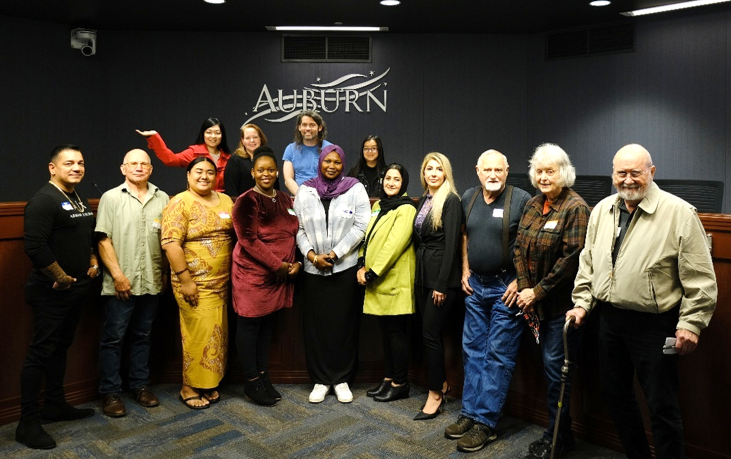
A picture of 14 community members who participated in the CHAMP project September 14, 2025. Chris Schmieder, Dorsol Plants, Erin Larson, Fathia Hammad, Harry Franqui, Hyesoon Shin, Lina Rauf, Merry-Christmas (Manuia) Seuseu, Oliver Markley, Rachael Gathoni, Rachel Vu, Saja Ahmed, Sandra Burroughs, and Steve Linder.
Missing: Ariana Vallejo. Photo credit: Addison Houston
Three key takeaways for community-led climate action
Takeaway 1: Bring Diverse Community Expertise Together
Community members brought knowledge about how extreme heat affects their neighborhoods, families, workplaces, and daily lives. The CHAMP project intentionally brought people together from different backgrounds to share their knowledge and experiences to develop solutions. Community members reflected that the diversity of the group made the process stronger, more engaging, and enriching. As one CHAMP participant expressed in the final focus group discussion:
“I think even having folks who are skeptical helps because they bring up gaps for us to see and then tackle...The discussions were helpful and then coming up with solutions and weighing the pros and cons for how they might or might not work here. This is a way for us to see how to move forward from the community perspective. The process of building and systems thinking among the group creates a process to move forward.”
Community expertise matters because they have firsthand knowledge about how they and their neighbors experience extreme heat, and what solutions will work best. Bringing those perspectives together to drive the discussion helped move beyond generic solutions to approaches tailored to the specific needs and strengths of Auburn.
Takeaway 2: Create a Shared Picture of the Problem
The risks people face during extreme heat are complex and impacted by many factors. During workshops, community members engaged in a key activity that helped map connections out to create a shared visual of the factors that contribute to the problem of extreme heat. The final visual (called a “causal loop diagram”), summarizes hours of discussion. Community members said that by breaking down the different contributors they could see more clearly where solutions could make a difference.
“My initial reaction is the causal loops are very complicated and as we reduced and analyzed them, we got to a place where we were able to look at solutions. It did come together and make sense. The process is useful. All of us absorbed it as we went along.”
More than a visual, building a causal loop diagram together created a shared understanding of extreme heat’s impact on health in Auburn. This helped the group contribute individual experiences to defining the problem, which also prepared the group to consider and propose solutions.
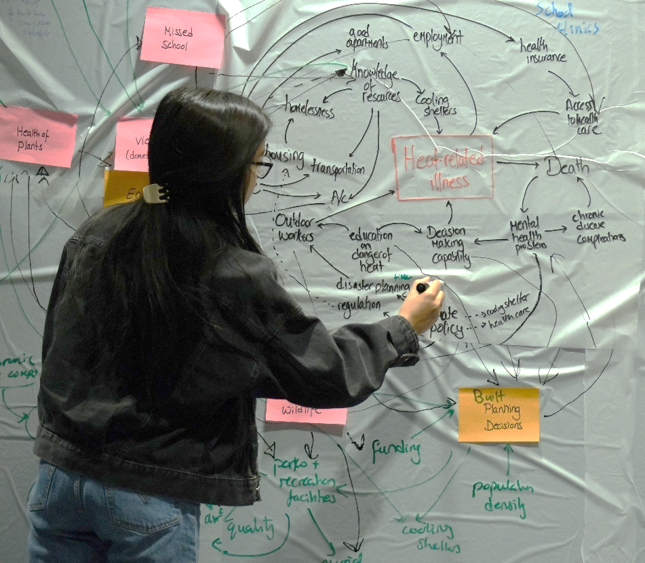
A picture of a Rachel Vu adding to the causal loop diagram. September 14, 2025. Photo credit: Addison Houston
Takeaway 3: Build A Path to Action
Community members were able to use the causal loop diagram to identify and prioritize solutions. The group identified 32 solutions and ultimately prioritized 10 solutions; many of which overlapped with the King County Extreme Heat Mitigation Strategy. What made this unique to Auburn, however, were the additional details about what implementation could look like at the local level.
Click the video below to hear Saja Ahmed, one of the community members who presented to the King County Board of Health, share some of the CHAMP solutions and her experience.
Moving Forward
Having involved partners at the City of Auburn helped create a bridge between community ideas and systems that can help move them forward. The City of Auburn continues to provide the CHAMP participants with updates on its progress to help implement the 32 recommendations, with the support of King County. CHAMP participants continue sharing information out in the community and advocating for solutions. Dorsol Plants, a community member and Executive Manager at South King County Housing and Homeless Partners (SKHHP), shared that through a partnership with SKHHP, the recommendations are being shared with neighboring cities to ensure this work can continue across South King County. Dorsol states,
“As a regional funder for affordable housing, SKHHP is ideally positioned to ensure local incentives, such as tax funding, and encourage the implementation of CHAMP recommendations, many of which tie directly into affordable housing and homelessness initiatives. By working with CHAMP to elevate community needs and concerns to local elected officials, SKHHP is establishing a clear pathway for collaboration and accountability.”
These solutions were created and are being implemented by Auburn community members but could be used in other communities like Auburn. Reach out to the Climate & Health Equity team (climateandhealth@kingcounty.gov) for more information on how to make this work for your King County city.
Additional Resources and Further Reading: